Buildings and environment
Cleaning and facilities: calculate the real cost of consumables
Consumable cost per square metre cleaned at maintained quality.
Industry guide · 4 min
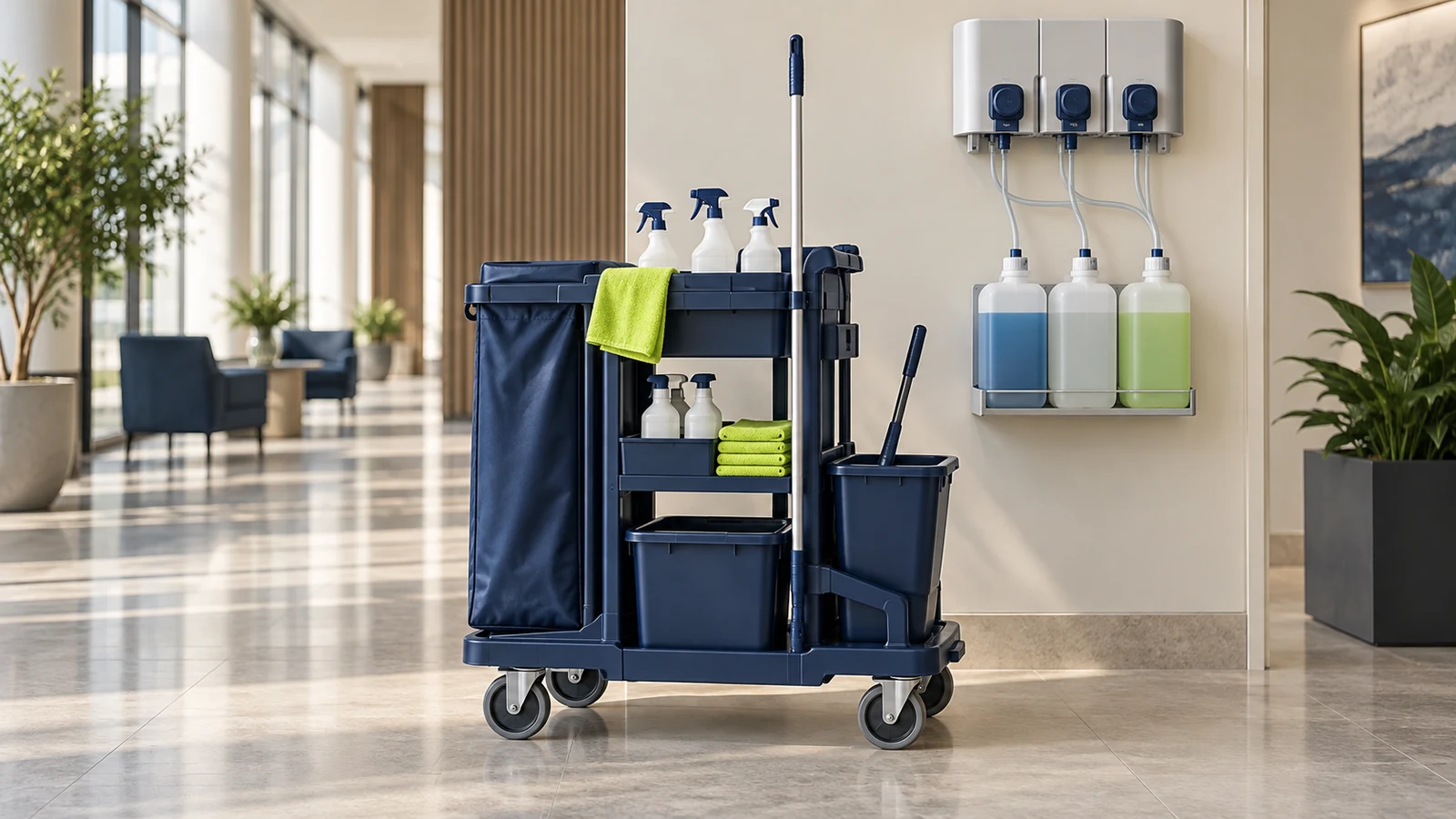
An application to explore with your team. Features, required data and connections will be confirmed for your context. Numerical examples are fictional.
01
The problem starts before the invoice
Container prices cannot compare concentrated and ready-to-use products. Dosage, surfaces and cleaning frequency determine usage cost. Procurement needs a link to site practices so negotiated improvements translate into consumption.
The question is not simply where to buy more cheaply. It is which information must come together before deciding, who can confirm the requirement and how to check the outcome after purchasing. Start with a manageable scope, retrieve existing records and make discrepancies discussable with the people who understand operations.
02
An application to develop with Kelqio
Calculate requirements using surfaces and dosage protocols, then compare usage costs. Review consumption differences with site managers.
The approach connects supplier information, catalogues, requests and orders. Each proposal should retain original references, the effective date of the terms used and the decision owner. Buyers can accept a suggestion, correct it or explain why it does not apply. That response becomes useful information for the next transaction.
Services and invoicing
Compare invoiced units with approved units and isolate amounts requiring evidence.
What if you changed an assumption?
Try it01 · Reference
Expected amount
5,000 €
02 · Your assumption
Invoiced amount
5,400 €
03 · Result
Difference to review
Invoice − (100 units × €50)
Educational simulation, fictional data. A positive or negative difference still needs explanation.
What the monitoring could look like
100 approved units at €50 gives an expected €5,000. A €5,400 invoice leaves €400 to substantiate, without assuming the review outcome.
Metric to adapt to your industry: Consumable cost per square metre cleaned at maintained quality.
AI-generated illustration of a proposed interface. Rules, data and approvals need to be defined with your team.
03
What makes a comparison useful
Site portfolios include buildings with different sizes, occupancy and equipment. Comparing raw bills can lead to poor conclusions. Choose a unit appropriate to the service and explain activity differences. Local managers should be able to confirm unusual conditions before they are labelled anomalies requiring correction.
Alerts need an identifiable next action: clause review, quotation request, maintenance work or service adjustment. Linking events, decisions and invoices preserves the result through follow-up. Suppliers can then receive specific requests with the evidence needed to explain or correct a charge.
04
Bring the right data together
Site surfaces, cleaning schedules, approved dosing, consumption and product prices.
First, check a few lines from end to end. Do references match across sources? Do amounts use the same unit and period? Are terms still valid? File imports can support this initial review. More automated connections follow once matching is understood and responsibilities are assigned.
Data freshness needs to stay visible. Old stock records, expired rate cards or unapproved documents can make a proposal unusable. Signal missing information and retain the last reliable state rather than presenting an apparently precise calculation based on incompatible inputs.
05
An example to explain the calculation
Take a deliberately simplified example on a comparable purchase line in this scope. For 1,000 units actually ordered, a €20 baseline price and €19 obtained price produce a €1,000 gross difference. If implementation adds €400, the net benefit is €600. These figures are fictional and do not estimate the result your organization should expect.
This checks the arithmetic, not the performance of the whole approach. Confirm the unit, period and purchased service, then retain invoices and additional costs. Explain volume reductions, removed services or different quality separately. Benefits only become realized after the corresponding transactions occur.
06
Measure what actually changed
Consumable cost per square metre cleaned at maintained quality.
Agree the baseline before claiming a benefit. Define scope, eligible volumes, quality, time period and costs required to change the situation. An identified opportunity, an approved decision, an order and an invoiced result are separate steps. Tracking them independently prevents an estimate from becoming a promise.
Cash released from lower inventory and staff time saved create value, but are not automatically recurring cash savings of the same amount. If outcome-based fees are appropriate, agree their calculation base. Subscriptions or fixed fees may better suit risk prevention and avoided costs that are difficult to verify.
07
Conditions for a useful result
Dosage must follow instructions and required quality. Lower consumption is insufficient if service deteriorates.
Approval should match the consequence of the decision. A different pack size does not require the same review as a new critical reference. Teams need access to the explanation, documents and person who accepted the change. This traceability also supports disputes and rule corrections without removing history.
08
Start with a real case
Choose a category, site or contract where the problem can be observed. Gather sample orders, applicable terms and available outcome evidence. The first exercise should cover the whole chain: data, proposal, approval, action and measurement.
Then compare processing time, matching quality and verifiable results. Errors and rejected proposals matter as much as gains: they reveal missing information or constraints. Expand once owners have a method they understand and can use routinely.
Questions to consider
Is this application already available for our organization?
These guides describe applications to explore with Kelqio. We will confirm feature availability, required connections and pilot scope against your systems and data.
Do we need to replace our ERP or specialist system?
The approach connects information already in use. An initial discussion identifies required data, decisions staying in your tools and connections to prepare.
How should we prepare a first discussion?
Describe your requirements, their owners and available sources. Useful data for this industry includes: site surfaces, cleaning schedules, approved dosing, consumption and product prices.
Further reading
These sources describe comparable mechanisms. They are not Kelqio customer references or performance results.
Cleaning and facilities
Your purchasing has its own requirements. Let’s talk.
Tell us about your contracts, flows or operational constraints. Together we can define a useful starting scope.